
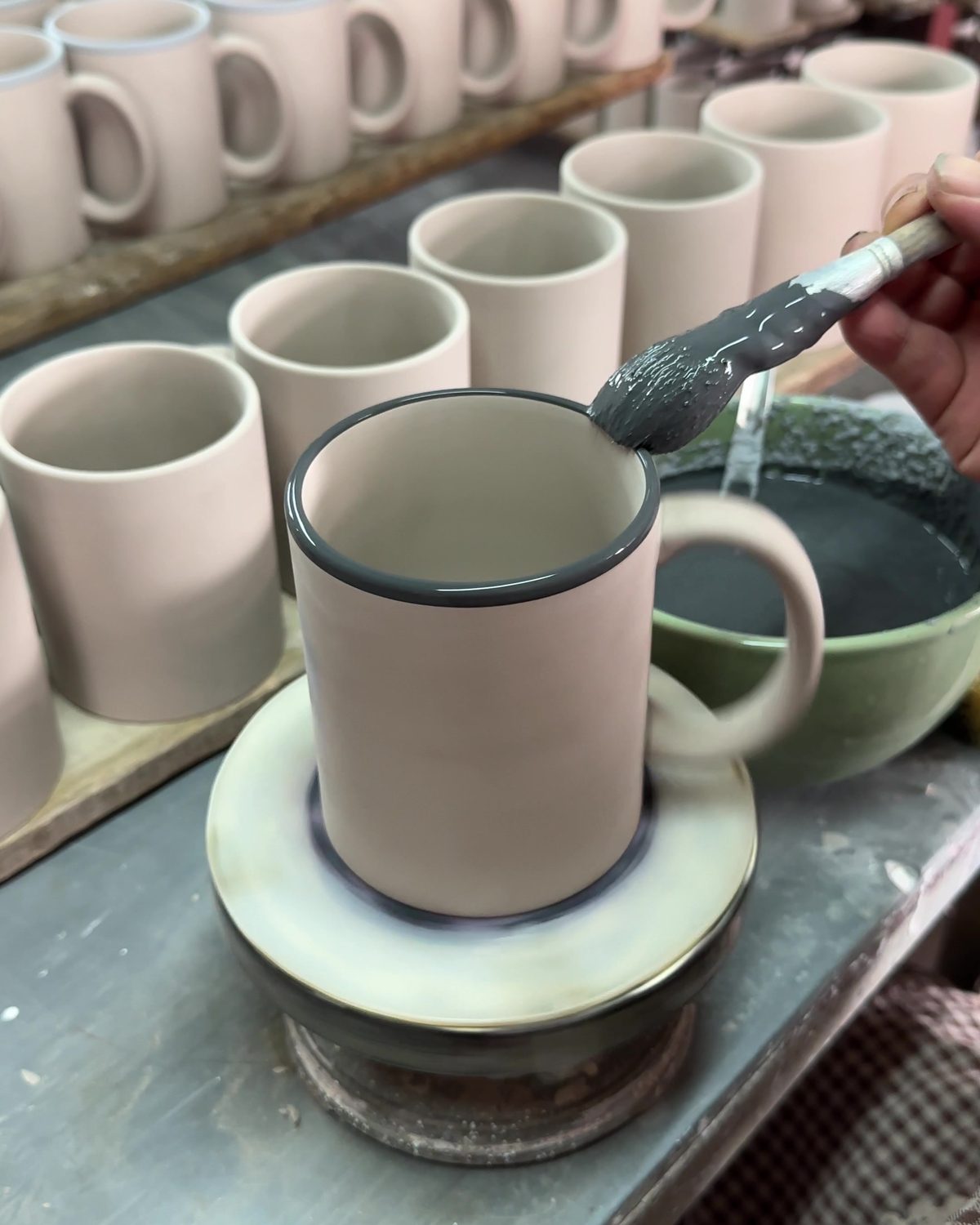
How a mug is decorated decides how it looks, how it wears and what it suits. Buyers often ask us which method is “best”. There isn’t one: each method does a different job, and many of the strongest designs combine two or three. This guide explains the methods we produce in our factory in Zibo, China, and how to choose between them.
Decoration methods at a glance
| Method | What it is | Best for | Good to know |
|---|---|---|---|
| Colour glaze | The glaze itself is the colour, inside, outside or both | Brand colours, home and café ranges | Matched to Pantone or a physical sample |
| Reactive glaze | Glaze that develops its own pattern in the kiln | Handcrafted, premium look | Every piece varies slightly |
| Decal | Printed transfer applied to the mug and fired on | Logos, multi-colour artwork, full-wrap designs | Fine detail and many colours possible |
| Screen printing | Ink printed directly onto the mug | Simple one-colour logos and text | Clean and economical for simple artwork |
| Sublimation | A coated white mug that the buyer prints with heat-transfer | Print-on-demand, photo and personalised mugs | Needs a straight or tapered shape |
| Embossing / relief | The design is raised or carved in the mug body | Logos you can feel, souvenir and gift mugs | Made in the mould, so it cannot wear off |
| Electroplating | A metallic finish over the glaze | Gift and seasonal ranges | Not for microwave use |
Colour glaze
With colour glaze, the colour is part of the mug surface rather than something added on top. We formulate glazes in-house and match them to a Pantone reference or your physical sample. The inside, outside, rim and handle can each take a different colour.
Choose it when colour is the design: brand-colour ranges, café cups, home collections. Custom colour-glazed stoneware is our best-selling product.

Reactive glaze
Reactive glazes change in the kiln, producing flowing colour and speckled texture. No two pieces are identical, which is exactly the appeal. It can cover the whole mug or just the interior, with a plain glaze outside.
Choose it when you want a handcrafted, premium feel. Make sure your customers understand that variation between pieces is a feature, not a defect.

Decal
A decal is a printed transfer that is applied to the glazed mug and then fired so it bonds with the surface. It is the most flexible way to put artwork on a mug: fine lines, gradients and many colours are all possible.
- On-glaze decal: fired at about 800°C. Most ceramic colours are stable at this temperature, so it offers the widest palette and the brightest results.
- In-glaze decal: fired at about 1,050°C, which re-melts the glaze so the decal fuses into the clear glaze layer. Fewer colours can withstand this temperature, so the palette is narrower and less vivid than on-glaze.
- Gold and silver decal: real metallic effects for premium and gift items.
- Full-wrap decal: artwork covering the whole body. We can also apply decals to the handle and the inside of the mug.
Our decal mugs are dishwasher-safe and microwave-safe, except designs with gold or silver, which must not go in the microwave.
Choose it when you have a logo or multi-colour artwork, or want a design that wraps the whole mug.
Screen printing
Screen printing applies ink directly to the mug. It gives a crisp, solid result for simple artwork.
Choose it when your design is a one-colour logo or line of text. For photographs, gradients or many colours, decal is the better route.
Sublimation
Sublimation is different from the other methods because the printing is done by you, not by us. We supply white mugs with a special coating; you transfer the image with a heat press. That makes it the standard choice for print-on-demand and personalised mugs.
- The mug needs a straight or tapered body. Curved, belly and footed shapes are not suitable for sublimation.
- Coating quality decides how long the print lasts. Our best coating grade withstands more than 7,000 dishwasher cycles without peeling or fading.
Choose it when you print small runs, photos or one-off personalised designs yourself. See our sublimation mug range.
Embossing and relief
Here the design is part of the mug’s shape: raised (embossed) or carved into the body. Because it is formed in the mould, it can never fade or wear off, and it gives the mug a tactile quality that print cannot.
Choose it when you want a logo people can feel, or a souvenir or gift mug with character. A custom embossed design starts with a new mould made from your drawing or sample, so it suits designs you plan to keep in your range.

Electroplating
Electroplating gives a mirror-like metallic finish in gold, silver and other tones.
Choose it when you want a striking gift or seasonal item. Electroplated mugs must not be used in the microwave, so they need clear care instructions on the packaging.
Combining methods
Most custom mugs use more than one method. Common combinations we produce:
- Colour glaze + decal logo: a brand-colour mug with a printed logo.
- Embossing + colour glaze: a raised logo on a coloured body.
- Colour glaze outside + reactive glaze inside: a calm exterior with a lively interior.
- Electroplating with decal or embossing: for premium gift ranges.
If you are not sure which combination will give the effect you want, tell us the result you are aiming for and we will advise on the most suitable route.
Decorating after delivery
Some buyers add their own decoration after receiving the mugs. Our mugs are compatible with laser engraving and UV DTF printing, as well as sublimation on coated blanks.
Quick answers
What is the most durable way to put a logo on a mug?
An embossed logo is part of the mug body, so it cannot wear off. Among printed methods, a fired decal bonds with the glaze and is dishwasher-safe.
Decal or screen print for a logo?
Screen printing suits a simple one-colour logo. Choose decal for several colours, fine detail, gradients or a design that wraps around the mug.
Can every mug shape be used for sublimation?
No. Sublimation needs a straight or tapered body so the transfer paper sits flat against the surface.
Which decorations are not microwave-safe?
Anything containing metal: electroplated finishes and gold or silver decals.
What are the minimum order quantities?
For new customers, a first trial order starts from 2,000 pcs per shape and 2,000 pcs per decal design, with 500 pcs per colour. See how custom orders work.
Related guides
- Reactive glaze mugs explained
- Sublimation mug coating: durability and how to check quality
- Ceramic mug MOQ explained
Have a design in mind?
Send us your artwork, reference photo or target colour. We will recommend the decoration method that fits and come back with options.