
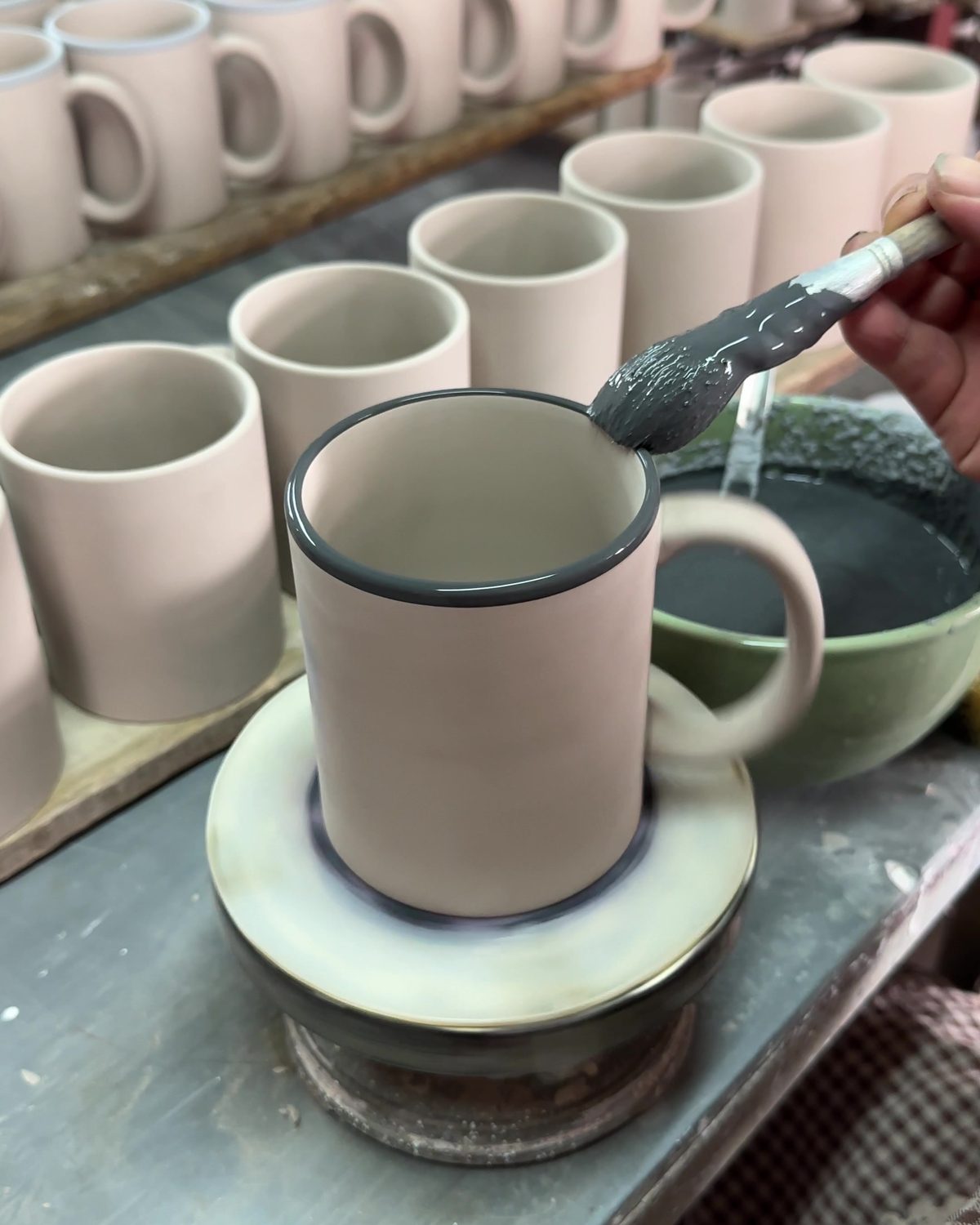
Two quotes for what looks like the same custom mug can be far apart. The difference is rarely random: it comes from a handful of things that change how much clay, time, kiln space and labour each mug takes. Here is how we see it from the factory floor, starting with the factor that matters most.

The four price factors, in order of impact
| Rank | Factor | What changes the cost |
|---|---|---|
| 1 | Quantity | Fixed set-up costs spread over more pieces; this applies to the mug, the decoration and the packaging |
| 2 | Shape | Capacity and weight, how complex the shape is, the handle, and how many pieces pass inspection |
| 3 | Packaging | Bulk, white box, colour box or gift box |
| 4 | Decoration | How complex each technique is, not just which technique you pick |
1. Quantity
Quantity has the biggest effect on unit price, and not only for the mug itself: decals, colour boxes and other packaging also cost more per piece in small runs. Every shape needs about 130 working moulds on the production line whatever the order size, plus the time to change the line over. Colour glaze is mixed in ball mills, and the smallest mill makes enough glaze for 500 mugs. Those fixed costs are spread across your order, so the larger the run, the lower the cost of each mug.
That is why our standard minimum is 5,000 pcs per shape, with 500 pcs per colour, and a first trial order can start from 2,000 pcs per shape. More in Ceramic mug MOQ explained.
2. Shape
- Capacity and weight. A larger, heavier mug uses more clay and glaze and takes more space in the kiln.
- Complexity. The harder a shape is to release from its mould, the slower and more expensive it is to form.
- Handle. Unusual handle shapes take more work to form and attach.
- Yield. Difficult shapes produce more pieces that fail inspection, and the cost of those rejects is carried by the good pieces.
3. Packaging
From lowest to highest cost: bulk packing, individual white boxes, printed colour boxes, gift boxes. Packaging also changes how many mugs fit in a container: a 40HQ takes about 70,000 standard mugs in bulk, or typically 50,000–60,000 with individual boxes. See Custom packaging for ceramic mugs.
4. Decoration
You cannot price a decoration technique without knowing how it will be done. Each technique has simple and complex versions, and the more complex it is, the higher the cost:
| Technique | What makes it cost more |
|---|---|
| Colour glaze | Two colours (for example a different inside and outside) cost more than one |
| Reactive glaze | Two glaze applications cost more than one |
| Embossed / relief | How easily the shape releases from the mould; complex shapes are harder |
| Decal | The decal paper is priced by the number of colours; labour depends on one or two sides, a small motif or a full wrap, and whether the handle or inside is decorated too |
| Electroplating | Full plating versus plating only part of the mug |
| Gold rim | Real gold versus imitation gold |
For how the techniques compare in look and durability, see Mug decoration methods compared.
Where a very low quote usually saves money
Quality follows price, and the savings in a very low quote are usually in places you cannot see when you place the order:
- A cheaper sublimation coating that fades after washing
- Looser inspection, so more pinholes, black spots and colour variation reach you
- No inner packaging or thin cartons, leading to breakage in transit
Some suppliers win the order with a low price and then ship lower-grade goods. We work for long-term customers, not one-off orders, and we never ship a lower grade than the one agreed. Every piece is inspected before packing; see how we inspect colour glaze mugs.
How to get the best mug for your budget
- Start from an existing shape. It avoids new moulds and gives more flexibility on quantity. Browse our 120+ shapes.
- Build volume. Combine several colours or designs on the same shape into one order.
- Spend where it shows. Simplify the decoration rather than the quality.
- Compare samples, not just unit prices. Judge each quote by the quality you will actually receive.
- Visit the factory, or ask for a video audit. Ask to see mugs coming straight out of the kiln before any sorting. If that unsorted ware is good, the inspected goods you receive are very likely to be good too.
To get a quotation, send us the shape (or a photo), quantity, decoration and packaging you have in mind through the inquiry form.