
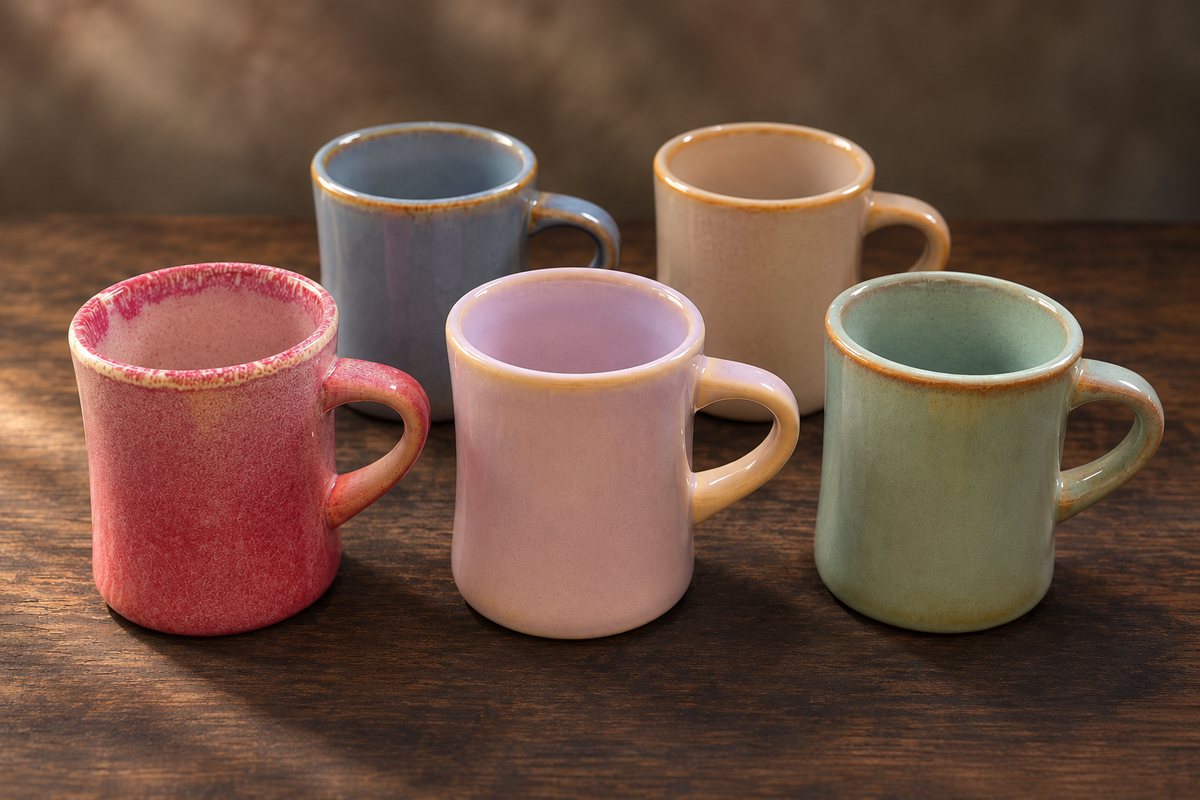
When buyers ask us for reactive glaze ceramic mugs, the first thing we explain from our factory floor in Zibo is simple: every reactive glaze piece comes out of the kiln with its own natural pattern. Unlike a solid Pantone glaze where every mug looks flat and uniform, reactive glaze flows and blends inside the fire, so no two cups will ever be 100% identical.
At Zibo HongDa Ceramics Co., Ltd. (Kunlun Town, Zichuan District, Zibo, Shandong; founded 2000; 24 production lines), our goal in bulk OEM production is not to force reactive glaze into looking stamped or artificial. Instead, we steer the overall colour direction and firing finish by controlling glaze layer thickness and wet glaze weight, then lock down the kiln conditions so a 5,000-piece run stays consistent enough for retail shelves.

Why Tunnel Kilns and Roller Kilns Fire the Same Glaze Differently
One detail many buyers outside the workshop miss is how strongly the kiln type affects a reactive glaze. In our factory, we operate both tunnel kilns and roller kilns, and both fire at 1,210°C. Even at the exact same peak temperature, the pushing or car speed and the atmosphere inside each kiln are different.
Because reactive glazes continue moving while molten, changing the kiln speed or atmosphere changes how far the glaze runs down the mug wall and how bright or muted the shade finishes. That is why we keep a production batch assigned to the same kiln, firing curve, and loading zone rather than splitting one SKU carelessly across different firing lines.
How We Steer Colour Direction: Layer Thickness and Wet Glaze Weight
Depending on the effect a buyer approves, our glazing workshop applies reactive glaze in either a single coat or a double coat (two passes of dipping or spraying). A heavier wet glaze coat gives deeper pooling, stronger speckling, and a clearer colour break along the rim or relief lines, while a lighter single coat keeps the surface tighter and less fluid.
Heavier double-coat reactive glazes also come with a practical firing risk: if the glaze flows too far down the side during 1,210°C firing, it can drip past the base and fuse the mug onto the kiln shelves (bats). On thick or high-flow glazes, our workers strictly control the foot-ring wiping height at the bottom edge of every mug so the molten glaze has room to settle without sticking to the shelf.
Five Controls We Actually Use on the Workshop Floor
You can read plenty of general background in our overview of how reactive glaze works and why glaze colour varies between batches. On our actual production floor, consistency comes down to five daily habits:
- Unified single-batch glaze mixing: For a customer order, we weigh raw materials strictly and prepare the glaze slurry together in one unified batch, followed by thorough sieving instead of mixing small scattered buckets mid-run.
- Checking slurry specific gravity (Baumé) and viscosity: Before and during shifts, glaze density and thickness are checked in the tank so wet pickup on the bisque stays steady from the first rack to the last.
- Controlling glaze layer thickness and glaze weight: Operators regulate dipping time or spray passes across single-coat and double-coat work to guide the colour direction and surface finish.
- Fixed firing curves and kiln-car record sheets: We load matching batches into consistent kiln zones under a fixed firing curve and track forming line, glaze tank, and kiln position with our physical kiln-car record sheets.
- Visual sorting by experienced QC inspectors: After firing, seasoned QC workers compare unloaded mugs side by side against the physical buyer-approved sample under natural daylight and fixed workshop lighting, culling pieces that drift outside the agreed look.
Design Choices That Make Repeat Orders Safer
If your brand wants the handmade kiln look of reactive glaze ceramic mugs without worrying about wild variation inside a retail carton, two practical design choices help a lot:
- Reactive glaze exterior with a clean solid or white interior: Shapes such as No. 3447 keep the drinking surface clean and uniform while letting the reactive glaze shine on the outside wall, making visual matching noticeably steadier on repeat orders.
- Mould-embossed logos or base backstamps: Raised or recessed relief textures look natural under flowing reactive glaze because molten glaze gathers slightly deeper inside recesses and thins over high points. For crisp brand lettering, a debossed mould mark or kiln-fired base backstamp stays sharp and dishwasher safe.
MOQ, Sampling, and Food-Contact Compliance
Across 183+ factory ceramic shapes in our Zibo plant, standard custom OEM MOQ is 5,000 pcs per shape and 500 pcs per glaze colour, with first-time trial orders accepted from 2,000 pcs per shape (500 pcs per colour still applies). Orders ship FOB Qingdao, and all food-contact stoneware and porcelain glazes are formulated to meet EU 84/500/EEC, EC 1935/2004, FDA, and California Prop 65 standards (lead and cadmium testing overview).
We support physical pre-production samples prior to bulk manufacturing, with sample scheduling confirmed against our current kiln and factory production plan. If you have a target glaze reference or shape in mind, review our custom OEM ordering process or reach out through our product pages for factory evaluation.
Common Buyer Questions
Will every reactive glaze mug in a bulk order look the same?
No. Reactive glaze creates an individual, one-of-a-kind pattern on every piece inside the kiln, so it will never be uniform like solid Pantone colour glaze. Rather than forcing identical pieces, our workshop controls glaze layer thickness, wet glaze weight, and firing conditions to keep the batch moving in the same colour direction and overall finish.
Why do tunnel kilns and roller kilns produce slightly different reactive results at 1,210°C?
Although both our tunnel kilns and roller kilns fire at 1,210°C, they have different car/pushing speeds and different internal kiln atmospheres. Those two factors change how long the glaze stays molten and how the reactive finish develops, so keeping an order on a consistent kiln curve and loading zone helps stabilize batch appearance.
When do you use single-coat vs. double-coat reactive glazing?
Single-coat glazing produces a lighter, tighter glaze layer, while double-coat glazing builds heavier glaze weight for richer colour depth and stronger flow effects. On thicker flowing glazes, we also control the foot-ring wiping height at the bottom so molten glaze does not drip and fuse mugs to the kiln shelves.
What is the MOQ for custom reactive glaze OEM orders?
Standard OEM minimum order quantity is 5,000 pcs per mug shape and 500 pcs per glaze colour, with a 2,000 pcs per shape trial option for first-time buyers. Pre-production physical samples are available before mass production, scheduled according to our live kiln plan.