
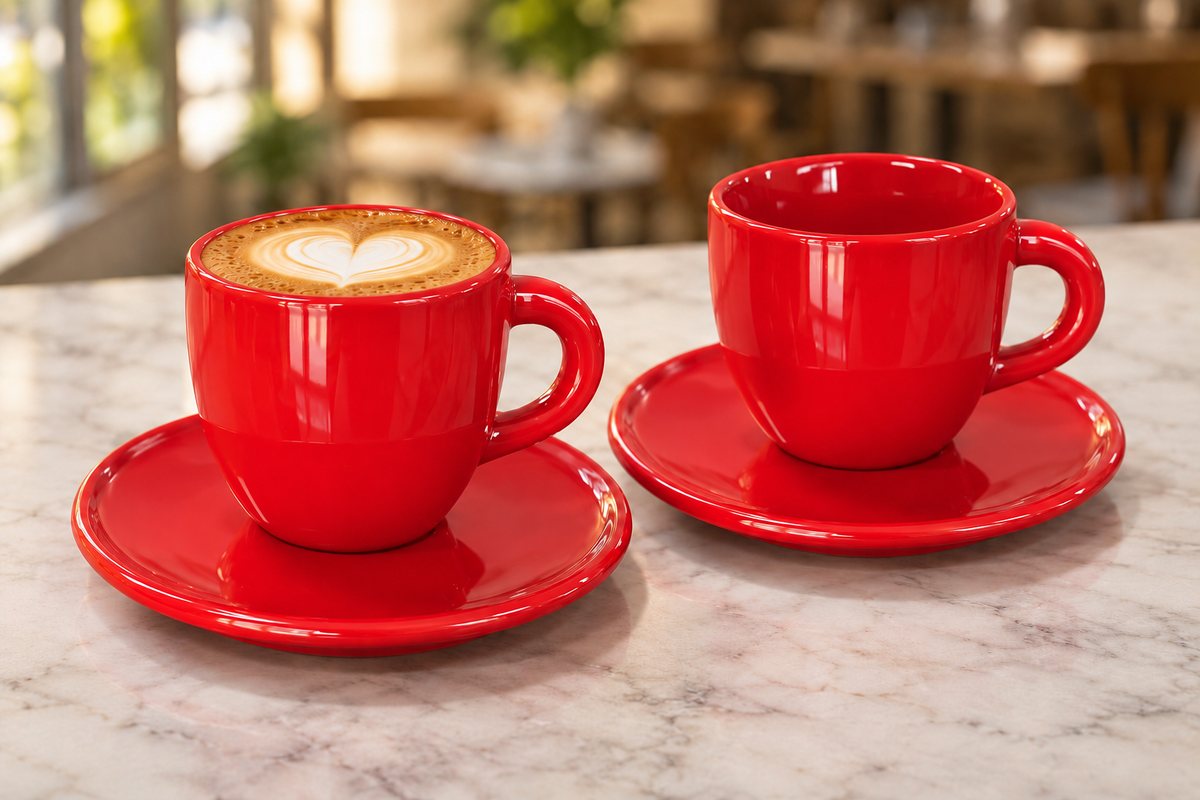
By Johnny Zhang, Zibo HongDa Ceramics Co., Ltd. — ceramic mug manufacturer in Zibo, China since 2000.
Quick answer: True red and bright orange ceramic glazes are the hardest colours to fire at stoneware temperatures (1,210°C) because ordinary pigments break down or shift brown in the heat. Reliable OEM factories use zirconium-encapsulated pigments, dedicated ball mills, tight glaze-weight control and signed limit samples to keep bulk batches consistent.
Every week, brand buyers send us Pantone swatches in vivid tomato red, bright mandarin orange or bold Christmas crimson and ask why one supplier’s sample came back muted terracotta while another quoted a higher price for red than for navy blue. The answer sits inside the glaze chemistry and the 1,210°C firing curve.
At Zibo HongDa Ceramics Co., Ltd. (Kunlun Town, Zichuan District, Zibo, Shandong; founded 2000; 24 production lines and 20+ glaze ball mills), we mill our own colour glazes in-house. Here is what actually happens inside the kiln when firing true red and bright orange ceramic mugs — and the practical controls wholesale buyers should check before placing a bulk OEM order.

Why True Red and Bright Orange Struggle at 1,210°C
Many common ceramic colours — cobalt blue, chrome green, iron brown and black — stay chemically stable well above 1,200°C. Bright red, scarlet, orange and vivid yellow behave very differently:
- Conventional iron reds shift dark: Standard iron-oxide pigments turn brick-red, rust or brown once firing climbs past 1,150°C, losing the clean bright hue brand guidelines demand.
- Unprotected selenium-cadmium reds burn out: Without a protective crystal shell, bright red-orange colourants volatilise or dissolve into molten glaze at stoneware peak heat, leaving pale salmon, washed-out orange or uneven streaks.
- Zirconium-encapsulated pigments solve the heat problem: High-temperature true red and bright orange glazes rely on inclusion pigments — microscopic colour crystals sealed inside a transparent zirconium-silicate shell. That shell shields the pigment at 1,210°C while keeping the fired glaze glossy, vibrant and food-contact compliant when properly formulated.
How Glaze Colours Compare on Firing Difficulty
Understanding which glaze families carry tighter kiln tolerances helps wholesale buyers budget unit cost, plan lead times and evaluate supplier samples accurately:
| Glaze Colour Family | Sensitivity at 1,210°C | Primary Factory Control | Practical Buyer Tip |
|---|---|---|---|
| True Red / Bright Orange / Vivid Yellow | High (narrow firing window) | Encapsulated pigment, dedicated ball mill, strict kiln zone & wet glaze weight | Approve signed light/dark limit samples; consider white interior for cost & food-contact margin |
| Navy, Cobalt Blue, Black, Forest Green | Low–Moderate | Consistent glaze specific gravity & base-glaze milling | Highly stable across repeat orders; ideal core shades for multi-SKU lines |
| Pastel Pink, Mint, Warm Cream, Grey | Moderate (contamination sensitive) | Dedicated clean ball mills & iron-free water/clay control | Check rim uniformity and interior speck control on pre-production samples |
| Reactive / Speckled Glazes | Intentional kiln variation | Glaze layer thickness, kiln speed & colour-direction control | Approve overall colour direction rather than piece-to-piece uniformity |
Why True Red and Orange Mugs Often Quote Slightly Higher
When a transparent factory quotes a modest price difference for vivid red or orange compared with white, black or navy mugs of the exact same shape, three real production factors explain it:
- Encapsulated pigment cost: High-grade zirconium-encapsulated red and orange stains cost significantly more per kilogram than iron, manganese or standard oxide pigments, and require higher pigment loading to achieve saturated coverage.
- Narrower kiln temperature window: Even a 10°C to 15°C shift across a kiln car can nudge bright red slightly darker or lighter. Tighter loading-zone discipline and careful firing curves are mandatory.
- Stricter visual sorting: High-saturation reds highlight pinholes, thin rim edges and glaze-thickness variations more visibly than muted tones, requiring extra attention during final white-glove sorting.

4 Factory-Floor Controls That Lock In Batch Colour Consistency
Consistent red and orange ceramic mugs are won before the mugs ever enter the kiln. Across our 24 production lines in Zibo, we rely on four repeatable workshop habits:
- 20+ dedicated in-house glaze ball mills: Factories that outsource glaze or wash one mill between dark and bright shades risk grey or muddy tint contamination. Running over 20 ball mills in-house lets us keep clean colour lines separated and control exact milling fineness — over-grinding an encapsulated red pigment can fracture its protective shell and wash out the colour.
- Wet glaze density & dip-weight control: A red glaze applied too thinly turns translucent orange-brown on the handle and lip; applied too thickly, it can crawl or pool. We measure slurry specific gravity and check wet glaze weight per piece during glazing shifts.
- Controlled kiln loading & traceable kiln-car records: Keeping a red or orange batch on the same kiln curve and uniform loading zone reduces shade drift across multi-thousand-piece runs, backed by our kiln-car traceability record sheets.
- Signed standard + light/dark limit samples: Because real fired ceramic glaze will always have slight natural shade tolerance compared with printed Pantone paper chips, we agree on a target sample plus acceptable light and dark boundary samples before mass production starts. Pre-production physical samples are scheduled according to our live kiln plan.

Smart Ordering Tips: Two-Tone Glazing, MOQ & Food-Contact Compliance
If you are sourcing red, orange or bright colour-glaze stoneware mugs for retail, cafés or seasonal campaigns, three buyer decisions make ordering smoother:
- Consider red outside + white inside: A bright red exterior paired with a clean glossy white interior keeps visual impact bold on shelf, reduces encapsulated pigment cost per mug, makes coffee crema look sharper in cafés, and gives maximum compliance headroom for US FDA, California Prop 65 and EU LFGB food-contact rim/interior migration tests.
- Split colours across one factory shape: Our standard OEM MOQ is 5,000 pieces per mug shape, with a first trial order from 2,000 pieces per shape across our hundreds of factory shapes. Within one shape, you can split into custom Pantone colour glazes starting from 500 pieces per colour — for example, 500 red, 500 orange, 500 navy and 500 cream on one shared body.
- Pair bright glazes with durable decoration: Glossy red and orange mugs work cleanly with high-contrast white decals, embossed or debossed logos, or hand-painted rim bands — all produced under one roof and shipped FOB Qingdao.
Quick Answers
Are bright red and orange ceramic mugs food-contact safe for the US and EU?
Yes, when produced with properly encapsulated high-temperature pigments and tested against target market limits. We formulate bright red and orange glazes to meet US FDA, California Prop 65 and EU LFGB lead and cadmium migration standards, and can arrange third-party lab testing before shipment. Choosing a white interior with a coloured exterior adds even greater compliance margin.
Why can’t red ceramic glaze match a paper Pantone book 100% identically?
Pantone chips are printed ink on paper, whereas ceramic glaze is mineral glass fired at 1,210°C. We match the closest achievable fired shade using our in-house ball mills, then send physical colour-glaze samples so your team approves the real ceramic finish and shade-range limit samples before bulk production.
What is the minimum order quantity for custom red or orange glaze mugs?
Custom glaze colours start at 500 pieces per colour within a mug-shape order of 2,000 pieces (first trial order) or 5,000 pieces (standard repeat order). That lets you test bright red or orange alongside core colours without over-committing inventory.
Can bright red or orange glaze be made in matte as well as glossy finish?
Glossy glaze produces the deepest, brightest red and orange saturation. Matte formulations soften the visual intensity slightly; if you want a tactile matte outer feel, we can prepare both gloss and satin-matte test pieces so you can compare them under natural light before deciding.
Related Guides
- Colour Glaze Ceramic Mugs — Custom Pantone Wholesale Manufacturing
- Matte vs Gloss vs Reactive Glaze Ceramic Mugs: A Wholesale Buyer’s Guide
- How to specify Pantone colours for custom glazed ceramic mugs
- Why ceramic glaze colour varies between batches — and how we control it
- Lead and cadmium testing for ceramic mugs
Need custom red, orange or Pantone colour-glaze mugs?
Send us your Pantone code, target mug shape and quantity. Our Zibo glaze workshop will advise on glossy, matte or two-tone options and prepare a factory-direct FOB Qingdao quotation.